
What are the key elements to unlocking in-store retail media?
Although digital retail media provides retailers and advertisers with a broad-reaching platform, in-store retail media is showing greater potential in influencing consumer purchase decisions. Currently, 84% of retail sales still occur in physical stores, prompting retailers to accelerate the deployment of in-store technologies such as sampling kiosks, digital endcaps, and smart shopping carts. However, measurement standards, privacy concerns, and personalization balance remain unresolved challenges for the industry.
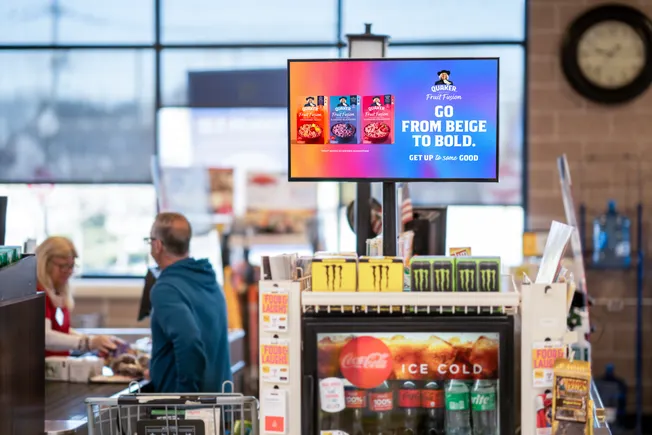
Digital retail media offers retailers and advertisers an unprecedented stage to reach consumers. However, this vast platform does not guarantee equally vast results when influencing customer purchase decisions.
Over the past few years, the grocery industry has rapidly accelerated its retail media footprint, with digital technology taking center stage in 2023, while this year, in-store capabilities have become the focus of attention.
Recently, retailers, advertisers, and industry experts have all noted that despite the many possibilities of digital technology, the influence of in-store retail media on consumers is becoming increasingly prominent.
According to a report released in July by in-store advertising provider Vibenomics, 84% of retail sales still occur in physical stores, making the potential of in-store retail media more critical than ever.
Kevin Bridgewater, senior vice president at retail media company Quad, said in an interview that advancements in in-store retail media are particularly beneficial for regional and mid-market retailers. He noted that these smaller retailers can more clearly articulate their customer base to CPG partners and explain why targeted product messaging can drive returns.
"For these smaller retailers, website traffic is not enough to excite brands, but foot traffic is quite substantial," Bridgewater said.
Grocers leverage in-store retail media capabilities to track shoppers' movements within the store and correlate them with basket and purchase behavior, which is crucial. Exposure (measuring whether customers saw the ad) and influence (tracking whether the ad drove a purchase) are both essential for grocers and CPG brands to understand campaign effectiveness.

Measuring influence
Experts say every area of the grocery store can be equipped with in-store retail media, with these devices strategically placed to maximize impact and gather more shopper data.
Sampling kiosks

The first type of retail media technology shoppers may encounter is the sampling kiosk, which offers customers the opportunity to discover products as they enter the store.
Gil Phipps, senior vice president of global customer solutions at Advantage Solutions and former chief marketing officer of Sprouts Farmers Market, said in an interview that kiosks are typically located at store entrances and are often interactive. This interactivity is crucial for measuring the impact of advertising messages.
Wakefern Food Corp. was one of the first to broadly deploy interactive kiosks in 2023, installing devices in 95 ShopRite and The Fresh Grocer locations. These kiosks, powered by Freeosk, distribute product samples after shoppers scan their phones, allowing the system to collect data and determine whether the trial led to a purchase.
Phipps noted that while kiosks offer a seemingly direct way to showcase advertising partner campaigns and gather shopper intelligence, their main drawback is their distance from checkout and primary product displays, especially compared to retail media messages more integrated into the store layout.
"Messaging at the entrance is important, but not as powerful as delivering a cereal message at the cereal shelf; of course, the closer you get to the product and the point of purchase, the stronger the effect," Phipps said.
Digital end caps and vertical banners

As shoppers venture deeper into the store, they may encounter digital end caps. These displays at the end of aisles are primarily used to draw shoppers' attention to featured products, such as limited-time seasonal items or everyday staples.
Once consumers enter the aisle, vertical banners—smaller screens attached to aisle displays that guide shoppers toward specific products—will next capture their attention.
These aisle-focused in-store retail media tools typically employ the same measurement strategies and technologies.
In April, The Save Mart Companies began rolling out in-store retail media technology as part of the launch of its In-Store Connect network, powered by Quad.
Bridgewater said in an interview that to measure advertising effectiveness, Quad collects transaction logs from its retail partners, including The Save Mart Companies, to measure SKU-level performance for participating brands in their categories.
Bridgewater said the end caps, vertical banners, and other aisle screens provided by Quad determine exposure through "shopper trap encounter technology," which senses and measures shopper movement in the store. The company then analyzes transaction and SKU-level data in conjunction with exposure.
Bridgewater said Quad then conducts A/B tests, also known as split testing, to track awareness, comparing results from stores in the network to those in the same chain not participating in the network.
Cooler screens

Grocers can also bring retail media to refrigerated doors.
Technology and retail media company CoolerX (formerly Cooler Screens) is one of the providers of digital refrigerator and freezer doors. These screens display ads and product information and allow shoppers to interact with digital merchandise.
Artem Lavrinovich, the company's chief data and product officer, compared this interaction to consumers clicking on digital ads. For its retail partners, CoolerX uses sensors on the screens to provide shopper behavior insights, including their distance from the screen, time spent in front of it, and the number of shoppers viewing it. This intelligence, along with store transaction logs, is timestamped, enabling CoolerX to understand the correlation between displayed ads and shoppers' baskets.
Lavrinovich said that if a customer stands for a long time in front of a CoolerX door screen, the company can push ads designed to influence their purchase choices, such as highlighting popular items behind the refrigerator door they are viewing or displaying QR codes offering additional information or promotions.
"The sensors are not just for counting how many ads were played, dwell time, and distance. They are actually used to identify where the customer is in their shopping journey," he said.
Smart carts

Smart carts are a way for grocers to consolidate nearly all functions of in-store retail media—ad delivery, personalization, in-store app features, loyalty program promotions, and digital screens—into a single device.
Although not yet as widely deployed as digital screens, smart carts are gaining popularity among grocers.
E-commerce provider Instacart is making a big bet on the power of smart carts, with its CEO Fidji Simo stating in May that it expects "thousands" of screen-equipped Caper Carts to enter supermarkets by the end of 2024.
As in-store retail media evolves, so do the capabilities of the Caper Cart. In January, Instacart launched ads on smart cart screens and began piloting the feature at Good Food Holdings locations. In an email announcement about the technology, Instacart said the feature enables CPG brands to engage customers with ads during the shopping trip and provide more personalized content based on past purchases and in-store shopping behavior.
Because smart carts are a newer type of in-store retail media, their measurement capabilities are less standardized than those of fixed in-store screens. In email comments, Instacart did not detail the Caper Cart's measurement capabilities.
What limits in-store retail media technology?
Although grocers can unlock deeper shopper behavior insights through newly acquired retail media capabilities, experts point out that progress is often hindered and the technology itself has limitations.
For example, while smart carts may be the next wave of in-store retail media technology, Phipps worries they could ultimately limit shopper spending.
Because carts have a limited capacity for items, Phipps is concerned that some special features, such as calculating a shopper's total before checkout, may fail when shoppers exceed the cart's capacity.
However, more pressing for consumers is the potential invasion of their privacy as grocers further personalize the shopping experience.
CoolerX, Quad, and Grocery TV said they currently do not capture or record personally identifiable information such as gender, age, and race. Instead, they rely on exposure to measure advertising effectiveness.
To dwell or not to dwell
Dwell time is one of the most common metrics measured by in-store retail media technology. While some experts claim it is a key way to track customer engagement, others argue it is less reliable.
According to Phipps, dwell time is a comprehensive measure of exposure because it captures how many customers passed by the ad and the time shoppers spent in front of it. This information can be combined with store transaction logs and time of day to indicate ad performance.
However, Bridgewater noted that Quad considers dwell time inaccurate for measuring an ad's impact on shoppers or collecting exposure.
"We don't think there is an accurate way to measure dwell time so that we can communicate to brands that they actually engaged with the media," he said. "[Shoppers] might be looking at the product, might be looking at something else, or might stop to look at their phone."
Grocery TV CEO Marlow Nickell and Director of Data and Analytics Dallas Griffin noted that the company attempted to measure demographic data on devices about five years ago but "quickly abandoned" the practice after inaccurate results. Now, the company relies on third-party audited exposure through a partnership with Placer.ai.
Lavrinovich noted that CoolerX's technology is similar to radar-based systems that sense human presence without collecting demographic details, while Quad measures ad effectiveness based on exposure, SKU-level sell-through, and retailer transaction logs.
"We don't have cameras on our devices. We also have no intention of putting cameras on our devices. Our belief, and particularly my belief, is that would cross the line of what customers expect," Bridgewater said, noting that collecting demographic information raises consumer privacy concerns.
Looking ahead, leveraging retailers' apps may be key to unlocking in-store retail media.
Retailer apps are the "most powerful in-store media surface," combining first-party data and in-store traffic insights, said Jordan Berke, founder and CEO of Tomorrow Retail Consulting and former Walmart e-commerce executive.
"When consumers use the app in-store, the potential for personalization, monetization, and highly targeted engagement opportunities for brands is significant," he added.
According to Berke, the next step in in-store retail media development is combining the power of apps with in-store digital screens to provide customers with the most personalized shopping experience. This development would involve enabling in-store screens to recognize when a customer's app is nearby and display product ads and store information on aisle screens that match their specific needs.
However, to reach this point, retailers need to convince customers to trade their privacy for this personalization, but Berke believes customers will be willing to accept this exchange.
"This is not a given, nor is it a low-hanging fruit opportunity," Berke said. However, the industry has "seen time and time again that if retailers can demonstrate and consistently deliver that value, customers will become comfortable with this exchange of [personal] information," he added.
Berke said connecting in-store screens to apps would also improve metrics for grocer brands and advertising partners, particularly incremental return on ad spend (iROAS).
Measuring iROAS requires precise attribution and control group creation. However, currently, grocers' in-store screen metrics are "loose" and cannot provide the highly detailed data advertisers seek, Berke said.
For example, Quad is preparing to launch a feature that allows people to opt in to link their retailer loyalty app, thereby receiving personalized offers (such as coupons), Bridgewater said.
"The fact that we can target customers in-store is significant... [Previously] you couldn't reach them in such an ideal environment when they are ready to make a purchase decision—until now," Bridgewater said.