
Super Bowl LVIII Ad Review: Star-Studded Lineup Fails to Mask Creative Fatigue, Only a Few Brands Break Through
Super Bowl LVIII ads were generally underwhelming, with overused celebrity strategies; only a few brands like CeraVe and State Farm earned praise through clever creativity.
Super Bowl LVIII delivered a nail-biting overtime showdown at Allegiant Stadium in Las Vegas, with the Kansas City Chiefs ultimately edging out the San Francisco 49ers to further cement their status as the NFL's new dynasty. However, the advertising battlefield off the field left many viewers puzzled—from Temu to RFK Jr.'s ads, few truly stood out or elicited knowing smiles, with most ads sticking to conventional playbooks.
That night, the romance between Chiefs tight end Travis Kelce and Taylor Swift became a focal point off the field, with Kelce's victory kiss after winning the championship sparking widespread discussion, though these side stories didn't overshadow the game's dramatic twists. In contrast, marketers attempting to replicate similar highlight moments largely chose safe strategies. After a year of culture war controversies, brands generally avoided risk, but the realities of the election cycle and global conflicts still occasionally seeped into ad content.
As with last year, too many companies relied on celebrity appearances (or even multiple celebrities) to grab attention, while humor, wit, and product relevance were noticeably absent. The abundance of lackluster cameos actually benefited ads with unique perspectives, such as CeraVe's quirky concept with Michael Cera, and State Farm's ad leveraging Arnold Schwarzenegger's accent—the latter ranking at the top of USA Today's Ad Meter.
"This year's Super Bowl was truly a 'kitchen sink bowl,'" said Jason Harris, president and CEO of creative agency Mekanism, in an email comment. "Advertisers overdid it. Instead of one celebrity, they crammed in five or six; instead of one clear joke, they piled on multiple. The result was ads so complex that viewers struggled to even remember the brand."
During CBS's broadcast, innovation was generally at a low ebb, with only a few ads promoting generative AI, while companies like DoorDash and TurboTax used QR codes to connect linear TV with mobile. Nickelodeon's synchronized broadcast was energetic and kid-friendly, earning considerable praise, but beyond that, the advertising feast didn't reach the glitzy standard Las Vegas should offer, aside from Usher's spectacular halftime show and numerous musical guests including Alicia Keys.
"The biggest surprise was how little brands were willing to take risks," said Andrew Hunter, executive creative director at Ogilvy, evaluating the Super Bowl LVIII ad lineup. "I think this will be a forgettable year. There were some highlights, but few brands gave us something to keep discussing beyond the news cycle."
Celebrity ads with cultural relevance stand out
Unsurprisingly, Super Bowl marketers heavily relied on celebrities to broaden their ads' appeal and buzz. But as more Super Bowl ads feature celebrities, establishing a genuine connection between the spokesperson, the brand, and popular culture becomes increasingly crucial.
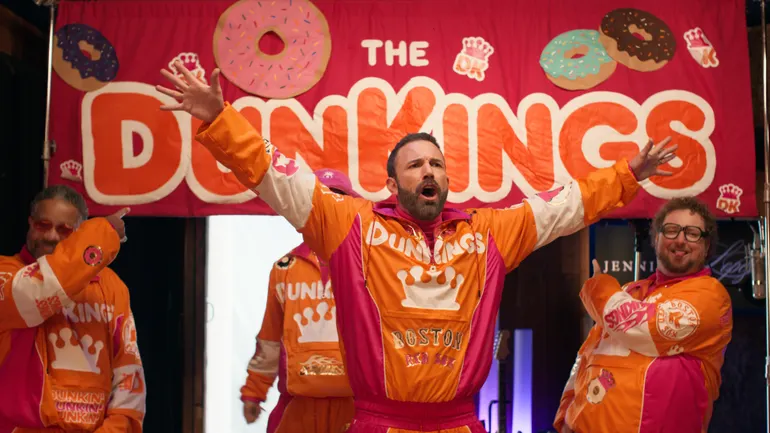
Dunkin' continued last year's Super Bowl highlight by extending its popular ad campaign starring famous brand enthusiast Ben Affleck, adding meaningful celebrity cameos. In a teaser ad aired during this month's Grammy Awards, Affleck pursued pop music stardom alongside wife Jennifer Lopez, friend Matt Damon, and New England icon Tom Brady, earning widespread acclaim.
"In terms of spectacle, entertainment, and branding, I'd vote for Dunkin'. They reinforced Affleck's connection to Boston and nailed the celebrity caricature style," said Ted Wahlberg, senior vice president and group creative director at Mower agency, in an email.
State Farm and BMW both effectively leveraged actors' distinctive accents: the former spoofed Schwarzenegger's pronunciation of "neighbor," while the latter paid homage to the enduring appeal of Christopher Walken impersonations. Both ads also included extra celebrity Easter eggs: State Farm reunited Schwarzenegger with his "Twins" co-star Danny DeVito, while BMW brought in halftime performer Usher.
Brands continued experimenting with viral "break the internet" ads, and Verizon put it into practice—its ad unexpectedly featured Beyoncé. The global pop superstar attempted to "break" Verizon's network through a series of increasingly exaggerated stunts: from running a lemonade stand, showcasing a robot ("Beyonc-AI"), to dressing as Barbie and performing in space. When none of that worked, Beyoncé teased new music at the ad's end, announcing a surprise album and new song release. Scott MacLeod, head of planning at VIA agency, called Verizon's Beyoncé strategy "a massive surprise in a Super Bowl full of teases and leaks."
"This move wasn't just about promoting Verizon (though it was done brilliantly); it was a masterclass in using the Super Bowl platform for maximum impact, seamlessly blending product placement, personal brand, and cultural moments—it was exhilarating," he commented in an email.
L'Oréal-owned brand CeraVe unveiled the conclusion of its ad campaign with Michael Cera. After weeks of pseudo-viral photos and podcast appearances, the actor pitched himself to CeraVe's board as the new spokesperson. This celebrity collaboration was clever, memorable, and consistent with the offbeat humor of comedy duo Tim and Eric, who directed the ad.
"For me, Michael Cera (CeraVe) won the game. It did everything a Super Bowl ad should: it was surprising for the category, used star power in a unique way, and was perfect for social media before and after the game," said Ogilvy's Hunter.
But beyond the few celebrity-driven successes, there were plenty of star-stacked ads that fell flat. Brands like Uber Eats, T-Mobile, Homes.com, E.l.f. Cosmetics, and Michelob Ultra all used the same playbook without hitting the mark.
"The celebrity multiverse opened a portal, unleashing countless relevant or completely irrelevant characters, and A, B, C-list stars," said Kyle Telman, associate creative director of experience at Siegel+Gale. "This trend presupposes that the more celebrities in an ad, the broader the audience reach."
More "what the heck" than "wow"
Before celebrities became the go-to strategy for Super Bowl ads, quirky humor and bold creativity once dominated. This year, much of the discussion centered on ads that were weird for the wrong reasons, such as Temu's animated ad that aired multiple times, looking like gameplay from a low-budget mobile game, leaving viewers confused about what the e-commerce platform actually does.
"Despite the strategic media placement, it didn't work well. There could have been so much more room for creativity and inspiration. Every time it replayed during the game, I felt it frustrated viewers rather than engaged them," said Rob Canales, chief strategy officer at The 3rd Eye, commenting on Temu's ad in an email.
Following industry trends, brands tried to avoid controversy and culture war minefields, with only a few like Dove placing purpose at the core of their ads. Yet, despite the NFL's attempts to avoid past mistakes, the broadcast was still filled with political and cause-related content.
"Although the NFL seemed to take an anti-political stance during Colin Kaepernick's kneeling protests, there were quite a few politically charged ads during the Super Bowl," said Joél Leon, creative director at T Brand Studio, in an email.
The Foundation to Combat Antisemitism made its Super Bowl debut with an ad calling for resistance against all forms of hate; Pfizer—whose COVID vaccine remains politically contentious—paid tribute to the history of scientific progress set to Queen's "Don't Stop Me Now," ending with a focus on fighting cancer. In regional ads, country singers Lainey Wilson, Jelly Roll, and Valerie June promoted healthcare price transparency for advocacy group "Power to the Patients"; the Church of Scientology invited people of all faiths to learn about the religion.
The night's biggest religious statement came from the Jesus-themed advocacy group "He Gets Us," which returned to the Super Bowl to promote inclusivity, but its two ads sparked confusion and dissatisfaction, with some questioning why religious groups would spend money on Super Bowl ads rather than directly helping others.
"I thought I was the only one confused, but after the first He Gets Us ad ended, someone at the Super Bowl party asked, 'What did I just watch?'," said Jason Wolske, executive creative director at David Miami, in an email.
The most politically charged ad was also one of the worst-received of the night: American Values Super PAC's ad supporting RFK Jr.'s presidential campaign—which recreated his uncle JFK's iconic 1960 ad—was widely seen as in poor taste, including by Kennedy family members opposed to RFK Jr.'s anti-vaccine stance, and also distracted consumers who didn't want to think about the future before the 2024 election.
"The upcoming election is the last thing viewers want to be reminded of during the Super Bowl," said Allen Adamson, co-founder of Metaforce, in an email. "For a candidate with more name recognition than both current leaders combined, repeating his iconic name was a complete waste, likely only making viewers wish JFK were still running."
The impact of absent liquor and automotive ads
Despite the lack of creative surprises, Super Bowl LVIII also saw notable absences in brand categories. Spirits—which had only relaxed restrictions on pro football advertising a few years ago—were absent this year after testing the waters in previous Super Bowls. This left ample space for longtime sponsor Anheuser-Busch InBev, which sought to boost struggling Bud Light as well as Budweiser and Michelob Ultra, while Molson Coors' Coors Light tried to capitalize on its competitor's troubles. The canned cocktail and hard seltzer boom that was active in Super Bowl ads in the early 2020s seems like a distant memory.
Bud Light's comeback attempt received a lukewarm response, while Budweiser's ad airing in the fourth quarter—centered as always on the Clydesdales—may have aired too late to make an impact.
"The return of the Clydesdales was great for Anheuser-Busch. They would have been better off using only that ad and dropping the Bud Light one," said Ronnie Goodstein, associate professor of marketing at Georgetown University's McDonough School of Business. "If that ad had aired earlier in the game, it would have been a real winner."
Automotive brands typically dominate the Super Bowl, but this year saw relatively fewer placements, though some performed well. Volkswagen's ad celebrating the 75th anniversary of the Beetle's arrival in the U.S. hit many elements of a classic Super Bowl campaign: using an iconic song, nostalgia, and brand history tributes, including its legendary 2011 ad. Volkswagen's success again showed that some marketers can make an impact by sticking to proven formulas rather than taking risks.
"Choosing Neil Diamond's self-deprecating 'I Am... I said' set the perfect tone for this always-humble brand," said Ryan Scott, vice president and group creative director at Innocean USA. "From retro-style clips to a tour of highlight moments like 'Vader Kid,' it reminded us of the brand's place in culture, and the copy 'We shaped its metal, you shaped its soul' is classic Volkswagen."
Emotional resonance is scarce
If liquor and automotive ads felt dull, the entertainment industry filled the gap with a barrage of movie trailers and streaming ads. Notably, host network CBS and its parent company Paramount ran a large number of ads, creating what Mower chief creative officer Doug Kamp called a "constant hum," but with limited effect. The massive promotion of TV and film aligns with Hollywood's efforts to capitalize on box office momentum and boost streaming profitability in the post-"Barbenheimer" era, with the shadow of Paramount's potential merger looming large.
AI also had its place in the Super Bowl spotlight, but if the technology promises transformation, it wasn't reflected in the marketing. Only Google's ad promoting the Pixel phone's accessibility features, which assist the blind or visually impaired, drew attention, becoming one of the few attempts at emotional storytelling, contrasting with the many tear-jerkers of past years.
"We rarely saw ads that truly tugged at the heartstrings. Kia and Google Pixel came close, but I'm not sure they brought tears like in past years," said John Cornette, chief creative officer at EP+Co, in an email. "Farmer's Dog was my number one last year, but this year I didn't see any ad that hit that emotional chord as strongly."