
Instacart Expands Full-Funnel Marketing with Video and AI
Retail media's role at the Cannes Lions International Festival of Creativity is shifting from a low-key performance channel to a connection point between creativity and commerce. This week, Instacart announced multiple product updates, including Ads Studio for co-creating with brands, and Immersive Feed, a TikTok-style vertical video shopping feed, and revealed that its AI shopping assistant will begin testing ads in the second half of this year. The company's Q1 advertising revenue grew 16% year-over-year to $286 million.
Cannes, Lyon - When retail media first debuted at the Cannes Lions International Festival of Creativity, it seemed somewhat out of place: a low-key, performance-focused channel appearing at an annual event celebrating bold creativity. As this annual gathering has become increasingly tech-centric - and arguably reached new heights this year - retail media networks have expanded further up the funnel, broadening their scope from sponsored search and display ads to areas like video and even brand entertainment.
"Seizing the opportunity to connect commerce and creativity is exactly where we should be," said Ali Miller, General Manager of Instacart's advertising business, in an interview in Cannes last week.
The grocery delivery platform, which partners with more than 2,200 retailers, unveiled a series of product announcements at the Cannes Lions festival, highlighting its intention to push beyond performance channels and move toward full-funnel marketing. These include the new Ads Studio, which invites brands to collaborate with Instacart on marketing campaigns and specific cultural moments, continuing initiatives like last year's Super Bowl promotion that featured cameos from numerous CPG brand mascots. Brainstorming, execution, and performance measurement will be supported by Instacart's first-party data, bringing its retail media division closer to its award-winning in-house creative agency, Local Produce.
"We really want to have conversations with brands before they've fully formed their creative concepts," Miller said. "Let's brainstorm together and create great ideas that can be activated throughout the year."
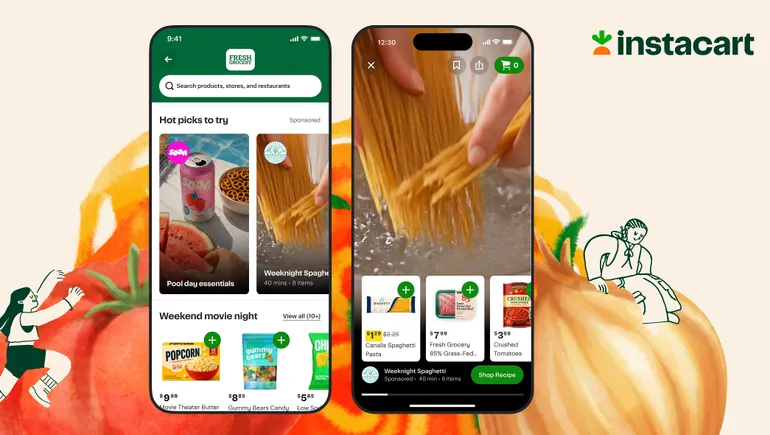
Another new offering is the Immersive Feed within the Instacart app, designed for short-form vertical videos. The experience is quite similar to content formats on TikTok, but features videos ranging from 5 to 30 seconds provided by brands. Hellmann's, Kettle & Fire, Rachael Ray Nutrish, and Siete Foods are piloting this format, which aims to drive discovery and transactions through recipe and product recommendation videos, with support for one-click add-to-cart functionality. Instacart plans to expand the feed to include native content through partnerships and sponsored creator integrations.
"When you think about recipe content, product demonstrations, personal care content, beauty content - vertical video is the perfect format," Miller said, adding that the potential for the Immersive Feed is "limitless."
The vision for AI advertising
Additionally, Instacart outlined its vision for an AI shopping assistant at the Cannes Lions festival. The assistant aims to help users solve problems such as brainstorming gluten-free meal ideas for a family of four. Miller said Instacart "may" begin experimenting with ads in the program later in the second half of this year. However, the executive noted that Instacart is taking a cautious approach to rolling out ads, considering user feedback rather than rushing to monetize. Instacart's first-quarter advertising revenue grew 16% year-over-year to $286 million.
"We really want this to be a two-way street," Miller said regarding AI.
What position the assistant will occupy within Instacart's advertising portfolio remains an open question. Other AI platforms that have begun showing ads are similarly "undecided" about their ultimate positioning within the marketing funnel. Sponsored recipes and scenarios - such as generating shopping lists for barbecue events - as well as displaying offers and facilitating product discovery, are potential applications Miller suggested.
"We'll see what consumers ultimately use AI for most. My assumption is that we'll see more of this upper-funnel, closer-to-mid-funnel behavior," Miller said. "I think it helps... move further up the funnel and drive more discovery."