
Cava's Lean Marketing Budget Belies Its Fast-Casual Dominance
Cava reported a 9% increase in same-restaurant sales and 5.3% guest traffic growth in Q2 2026, beating Wall Street expectations despite a marketing budget of just over 1% of revenue. The chain's strategy emphasizes local creator partnerships, in-house content, and unique experiences like the Mediterranean Summer Supper Series with Airbnb.
Cava continues to outperform fast-casual rivals such as Chipotle and Sweetgreen, reporting on Tuesday a 9% rise in same-restaurant sales and 5.3% growth in guest traffic during Q2 2026. While these figures mark a slight deceleration from Q1's 9.7% and 6.8%, respectively, the chain still beat Wall Street expectations.
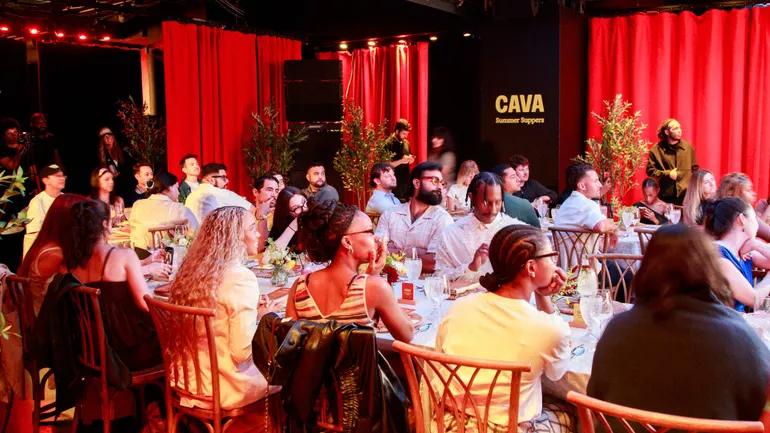
Beyond touting its category-defining brand and value proposition, CEO and Co-founder Brett Schulman highlighted on an earnings call the success of the Mediterranean Summer Supper Series, a three-part dining experience launched this summer in partnership with Airbnb. The events drew nearly 300 guests and generated over 6 million content views, according to details shared with Marketing Dive.
“I think you'll be seeing some more analog-type experiences from us that then can create that amplification or network effect on social channels versus some of the tactics that were more utilized over the last couple years that I think have been challenged in the recent changes in the landscape on social media,” Schulman said on the call.
Cava's competitors remain active on the marketing front. Chipotle expects marketing costs to represent about 3% of sales for the full year, while Sweetgreen last year increased marketing spend and has recently shifted its marketing mix toward upper- and middle-funnel media.
To further bolster its marketing efforts, Cava—which went public in 2023—is currently in the process of hiring a new CMO focused on brand marketing and creative, Schulman said. Andrew Rebhun, previously the chain's chief marketing and experience officer, joined Panera as CMO last week.
Marketing Dive earlier this summer spoke with Nitya Madhavan, senior vice president of brand and marketing at Cava, about the chain's efficient marketing approach, creator partnerships, AI experiments, and more. Madhavan's remit spans the full marketing funnel: creative, public relations, communications, social partnerships, brand marketing operations, media, loyalty, and user experience.
The following interview has been edited for clarity and brevity.
MARKETING DIVE: Cava spends just over 1% of revenue on marketing. How does that affect your strategy?
NITYA MADHAVAN: We are very fortunate to be a brand growing rapidly, and we're on track to hit 1,000 restaurants by 2032. As we expand, we see it as an opportunity to broaden brand understanding and awareness. We employ a lot of local marketing efforts, whether reaching out to local creators or influencers to spread the message or tapping into the community.
With such an efficient marketing spend, we use social as a key part of our strategy—both organic and unpaid—but it's crucial to partner with creators and build content that aligns with our values. We're not chasing trends or paying for endorsements. We partner with people and brands where their genuine love for Cava, understanding of our food's nourishing and delicious benefits, really comes through, maximizing our reach that way.
How are you approaching creators as that part of marketing continues to grow across industries?
Social has changed significantly in terms of content consumption and creation. We have a robust in-house social team responsible for overall strategy, and we've increased investment in in-house content creation, bringing on more dedicated people. We have our own partnerships with creators who reach out or with whom we've worked before. Where it makes sense, we also partner with agencies, like our New York bear stunt in April—a fun idea that came from our social agency, Loop. We'd been discussing bears loving salmon, and they had similar inspiration, so we collaborated on execution.
You previously worked at Instagram and Meta. How do you see social channels evolving?
We constantly monitor algorithm changes and viewer preferences. As social media natives, we observe what content is served to us and have taken new bets this year. A great example is our Bowlmates dating show, where we created a separate channel, knowing content can have its own moment and that algorithms serve content to non-followers. How do we reach these non-followers and help them understand our story, tapping into what people watch—which is increasingly short-form content?
I saw Instagram is going on TV, so this space will continue to grow and become more complex. We're open to trying new things as long as they connect back to our concept, essence, and values.
How is Cava approaching loyalty as part of the marketing flywheel?
We've significantly invested in and improved our loyalty program over the last year. For us, loyalty is more than points and spending—it's about building relationships with guests by providing access to information, rewards, and a sense of community. We'll invest in more personalized experiences. This year, we're exploring gamification ideas, like collecting badges or fun games in the app, to engage loyalty members and give reasons to return.
We also launched our tiers program this year, with three main tiers and a secret, invite-only tier called Oasis for our most frequent guests. The goal is to build personal connections with Oasis and loyalty members. We believe personalization and recognition will become increasingly important, and we strive to create one-to-one experiences within our restaurants every day.
Artificial intelligence continues to be a focus in marketing. Where is Cava with AI?
We're definitely exploring AI for efficiency and productivity, and we're watching to understand its role in generative creative for the industry and Cava. We're open but cautious and thoughtful about AI use. We've integrated it internally for process efficiency and idea development. However, in terms of outward-facing creative, you won't see much AI yet. Much of our content remains organic, human-captured, and based on human interactions with guests—something we want to continue investing in.
I'd love to revisit this conversation in six months to see where we are, as it's top of mind for our team to constantly explore and understand how we market.