
2025 CTV and Retail Media Convergence Trends Preview: What Marketers Should Watch
With Amazon launching the AI-driven CTV advertising product Brand+, the convergence of retail media networks (RMNs) and connected TV (CTV) will enter a new phase in 2025. Industry experts point out that this convergence will bring more precise data matching, scaled personalized creative, and the implementation of shoppable ads, but it also faces challenges such as a lack of measurement standards and industry fragmentation.
This week, Amazonannouncedthe addition of Brand+, a new member of its advertising product suite, which leverages artificial intelligence (AI) to optimize connected TV (CTV) and online video advertising. This new solution integrates vast shopping, browsing, and streaming signals to help brands reach potential consumers across Amazon channels like Prime Video and Twitch, as well as video publishers such as Buzzfeed and Dotdash Meredith.
In a hypothetical use case provided by Amazon, a travel company could upload first-party data to Amazon DSP, and the new feature would use machine learning to identify users who have searched for travel gear, purchased travel guides, and watched travel shows, then serve ads to these high-potential audiences.
Some Brand+ testers reported sales increases of over 10% and website traffic growth of more than 70%. This places Brand+ alongside other AI-driven tools available to advertisers, such asGoogle's Performance MaxandMeta's Advantage+. More importantly, Brand+ demonstrates how the convergence of retail media networks (RMNs) and CTV can address marketers' core needs.
"As marketers increasingly focus on precision and return on investment, retail media CTV will redefine the advertising landscape," said Dave Peterson, General Manager and Global Head of Retail Media at Epsilon, in an email comment. "Prioritizing impactful, personalized campaigns over broad reach allows brands to build deeper, more meaningful connections with consumers."
According to eMarketer data, by 2028, CTV ad spending is projected tosurpass traditional TV ad spending, while omnichannel retail media will account fornearly a quarterof total US media ad spending. The continued growth and dominance of these two symbiotic, synergistic channels could ultimately fulfill digital marketing's promise of full-funnel, data-driven marketing.
"Looking at the goals of brands, especially Fortune 500 companies, they want to engage specific audiences at every available touchpoint based on first-party data from retail media networks," said Oz Etzioni, CEO of advertising personalization platform Clinch. "Before CTV, this capability was quite limited... CTV truly opens up the full spectrum of communication with consumers and guides them down the funnel."
Better data, stronger partnerships
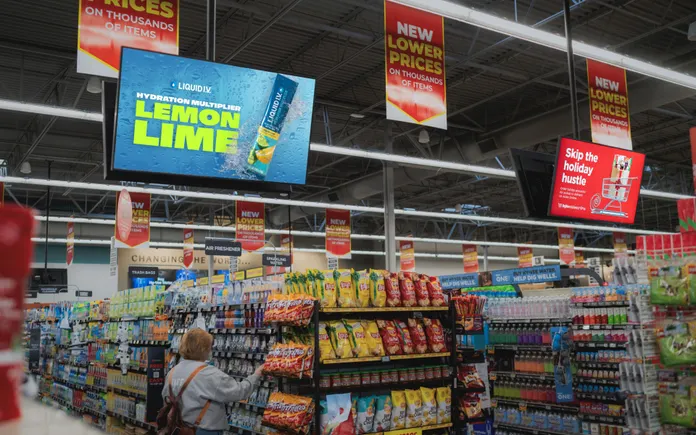
Over the past few years,partnerships between retailers and media companieshave increased significantly—NBCUniversal with Instacart and Walmart, Disney with Walmart and Kroger, Roku with Instacart, among others—as both sides seek to capitalize on the RMN-CTV convergence. For retailers, CTV extends their media businesses to off-site ad inventory.
"Authenticated data from CTV is extremely valuable, and it enables better identity matching compared to what social platforms can achieve with their authenticated data," noted Jeffrey Bustos, who recently joined Merkle, a Dentsu company, as Senior Vice President of Retail Media Analytics from the IAB. "As data signals continue to erode, we will see more of these applications."
Authenticated data allows advertisers to reach audiences without relying solely on their own deterministic data, expanding reach from a specific retailer's consumers to, for example, millions of users watching YouTube or Netflix.
Bustos added: "As a retailer, I can use CTV data to create lookalike audiences, target a broader group than my own audience, and then see how many people from that larger group subsequently make purchases in-store or online. That's where the value lies."
On the measurement front, the combination of CTV and RMNs enables advertisers to understand campaign performance more easily and quickly. Bustos explained that the collaboration model between clean room provider Habu and Kroger and Disney on audience activation is a glimpse of what advertisers can expect, especially as firms like Circana and Dunnhumby begin offering cross-retailer attribution services. However, work remains in connecting data pipelines and standardization.
"We are working with the IAB to drive a unified standardization approach across all retail media networks as they move up the funnel, enabling them to use conversion metrics in a comparable way, so we can holistically evaluate media investments, determine optimal placements, and trust the results," said Jill Cruz, Executive Vice President of Commerce Strategy at Publicis Commerce.
Personalized creative at scale
CTV has long been seen as a channel that can meet marketers' needs for personalization at scale. As ad tech in the CTV space matures, especially with the rise of AI, advertisers can leverage the purchasing power of retail media networks to deliver on this promise. For example, brands using Kroger Precision Marketing can buy that retailer's audiences across platforms like Roku, Disney, and YouTube—scaled in a way consistent with programmatic buying.
"In advertising, scale and automation are critical," Bustos said. "Retailers or brands using retail media data can now reach multiple CTV partners with the same creative, thereby scaling CTV buys."
"Retail media creative is sometimes the graveyard of creativity."

Jill Cruz
Executive Vice President of Commerce Strategy, Publicis
Beyond versioning and personalization, as advertisers become more familiar with the space, more creative experimentation may emerge in CTV. Cruz explained that instead of repurposing 15- and 30-second ads, agencies have the opportunity to make more compelling attempts.
"Retail media creative is sometimes the graveyard of creativity," the executive said. "CTV can change that. Creative can be more customized, speaking to audiences in ways that more directly drive cart conversion rather than just building brand equity. This is an opportunity area for 2025."
Beyond delivering more engaging and personalized ad experiences, the combination of CTV and retail media also gives advertisers more avenues to connect with consumers.
"We're seeing different ad units, different ad experiences involving second screens, external data like geolocation, weather, and sports," said Clinch's Etzioni. "I think there's a huge opportunity, especially for advertisers that aren't purely performance-driven."
The shoppable future
Melanie Babcock, Vice President of Orange Apron Media and Monetization at The Home Depot, believes the growth of retail media and the proliferation of shoppable formats may heighten the need for measurement standards.
"We're excited to see media partners elevate RMNs as one of their key customer segments," Babcock wrote in an email comment. "We will continue to see use cases of how RMNs apply AI to operations, creative development, and ad delivery."
"Just because the technology exists doesn't mean we should use it."
Jeffrey Bustos
Senior Vice President of Retail Media Analytics, Merkle
Shoppable TV has been a hot topic among media companies and marketers for years, so much so that "buying Jennifer Aniston's sweater" has become a cliché in the ad industry. But the rise of AI and other machine learning technologies is bringing the vision of shoppable ads closer to reality. For example, video platform Kerv.ai uses AI-driven video analysis to identify objects in content and match contextually relevant ad experiences. The company works with NBCUniversal, Warner Bros. Discovery, Paramount, and Disney.
"Leveraging the retail media ecosystem is a key partnership initiative for us," said Gary Mittman, CEO of Kerv.ai. "Why wouldn't an RMN want to add relevance and engagement value to its impressions? That's where we fit perfectly."
Still, the rise of better shoppable ad formats leveraging CTV and RMNs doesn't mean they're suitable for all marketers. Few consumers are ready to buy a car via remote control, and many are already weary of the QR code renaissance.
"Just because the technology exists doesn't mean we should use it," Bustos explained. "We have to recognize that consumers are very lazy."
A crowded 'Wild West'
If consumers are overwhelmed by the proliferation of CTV and streaming platforms, advertisers trying to make sense of the retail media network landscape face an even bigger challenge—with some estimates putting the number of players at over 200. While most RMN ad spending is concentrated among a few major players, the rest must find ways to offer competitive advantages or risk being left behind.
"You will definitely see consolidation," said Barry Thomas, Senior Retail Thought Leader at Kantar. "Large brands won't allocate budgets to B-level media networks, so a lot of consolidation is happening... For most players, that's the future."
While some RMNs have signed with the likes of Instacart or Criteo to improve their market position, Cruz explained that this strategy often leaves these platforms in "no man's land," unclaimed by both brands and agencies. As the adage goes, not every business can be Amazon.
"Large brands won't allocate budgets to B-level media networks, so a lot of consolidation is happening."
Barry Thomas
Senior Retail Thought Leader, Kantar
"Innovation will come from identifying other B2B opportunities, such as selling supply chain capabilities, licensing proprietary technology, or offering other forms of data-driven insights," Cruz said.
The fragmentation of retail, retail media, and CTV could help smaller players in each space find new revenue streams and partnerships, creating a rising tide effect. Advertisers might be able to benefit from this fragmentation—something that wouldn't be possible if these channels were completely separate.
"This could be a win-win for retailers—they can say 'we want to attract younger foot traffic to buy our products in-store'—while CTV can also leverage these audiences for greater reach," Cruz said.