
Banks Race for 'First-Mover Advantage' in the Metaverse: Virtual Layouts from JPMorgan to Quontic
As the metaverse concept heats up, banks like JPMorgan and Quontic are setting up outposts in virtual worlds, attempting to seize a first-mover advantage. This article analyzes the differences in metaverse strategies, regulatory challenges, and industry prospects across banks of varying sizes.
JPMorgan Chase released its annual summer reading list last month, a tradition that has continued for more than two decades. But this year, the bank took a slightly different approach—placing the books from the list in a virtual lounge it set up on Decentraland in February for visitors to browse.
This move reflects JPMorgan Chase's bet on getting an early foothold in the metaverse. The bank believes this immersive world, explorable through virtual reality and augmented reality headsets, representsa $1 trillion market opportunity。
Sandeep Vishnu, a partner at consulting firm Capco, noted that the metaverse is a virtual world users explore with VR/AR devices, representing a new model of social interaction and engagement, and banks cannot afford to be absent from this space.
"If the metaverse is a new model of society, interaction, and engagement, then banks must keep up," Vishnu said. "Banks have to figure out what role they will play in the metaverse. Acting early and being part of the ecosystem may give them some first-mover advantages that would no longer exist if they are slow to act."
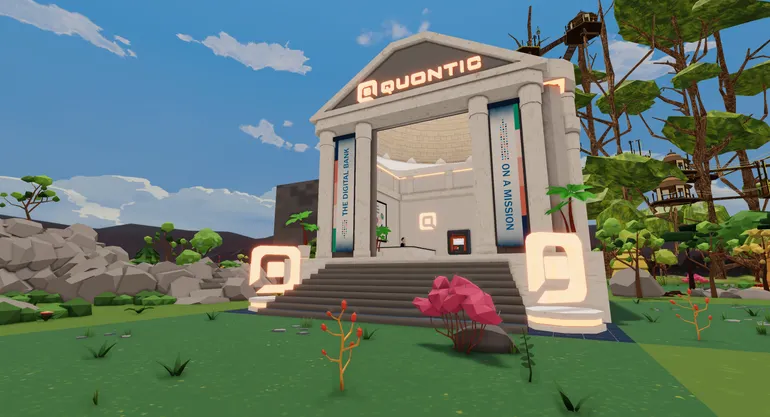
Similar to JPMorgan Chase, New York-based digital bank Quontic Bank has also adopted a first-mover strategy. Last month, the bank also opened aQuontic Bank outposton Decentraland. To celebrate the opening, the bank hosted a virtual launch party with a DJ and a giveaway of limited-edition non-fungible tokens (NFTs).
Quontic's Chief Marketing Officer Aaron Wollner said the bank's discussions about establishing a presence in the metaverse began earlier this year. "We did an assessment of investment versus impact, and we expected the investment to be relatively low while the impact could be high—not immediate, but with potential," Wollner said. "That's how we sometimes think about innovation: what is the potential upside, even if there is no immediate impact?"
The digital bank has been committed to being at the forefront of blending new technology with the banking experience. Quontic claims to be the first U.S. bank to offer customers aBitcoin rewards program, a feature launched in 2020. The bank also says it is the first to introducetap-to-pay mobile payment ringsto the U.S. market, with the product officially launched in April.
Wollner said Quontic is excited about providing customers with a three-dimensional spatial experience in the metaverse. "We love our digital, dot-com experience, but it's two-dimensional and a bit flat," Wollner said. "We try to extend that experience through chatbots and various forms of automation, but at the end of the day, it's limited."
Wollner noted that JPMorgan Chase launched its Decentraland lounge months before Quontic opened its space, and Quontic sees this as validation of its own efforts in the virtual world. But Wollner added that Quontic views the large bank's approach to the metaverse as an example of what to avoid.
JPMorgan Chase's Onyx Lounge, named after its Ethereum-based service platform, features a roaming tiger, a spiral staircase, and a portrait of CEO Jamie Dimon. "We thought that was very self-promotional," Wollner said, referring to the Dimon portrait and the space's promotion of its new cryptocurrency business. "It was more about JPMorgan itself than about the customer... We became even more convinced of the idea: 'If we're going to do this, do it for our customers, build it for them.' That's the approach we took."
Wollner said the bank is operating the space with an educational approach, inviting customers to visit and learn about Decentraland, crypto wallets, and how tradable digital assets work. "Just click the button on our metaverse landing page, and you can jump in, and there you are, experiencing the Quontic metaverse," Wollner said.
But as for operating the space as a fully functional branch, Wollner said Quontic is taking a "wait-and-see" stance. Wollner said the concept of using the metaverse as an extension of a financial institution's banking operations raises several unresolved regulatory and security issues. "We are a highly regulated financial institution and take compliance and risk very seriously," Wollner said. "Before we conduct any banking business in our Decentraland outpost, we must ensure that security, regulatory compliance, and all other aspects are properly addressed, and that remains largely to be determined."
Vishnu said it is only a matter of time before regulators turn their attention to the metaverse, and they are likely to focus on fundamental elements of financial regulation, such as identity management, know-your-customer (KYC) transactions, and the application of anti-money laundering rules in the virtual world. "Regulation will become a concern for banks, but in my personal view, maybe not yet," Vishnu said.
Vishnu noted that navigating the metaverse using virtual avatars also presents its own security and identity challenges. "One of the biggest considerations in the metaverse is the identity management aspect of security," Vishnu said. "Do you know who you are actually dealing with? Establishing a link to real people and real identities will be crucial." Although the virtual world presents a new form of customer interaction that banks need to consider, Vishnu said banks should handle identity verification in the metaverse the same way they handle it in digital and mobile channels. "It may be a new form of interaction, but the considerations will be similar," Vishnu said.
Does this make sense for banks?
Besides JPMorgan Chase and Quontic, other financial institutions are also planting flags in virtual metaverse land. In March, London-based HSBC purchased a plot of land in The Sandbox, a virtual world primarily used for gaming. HSBC said the space will be used to engage and connect with sports, esports, and gaming enthusiasts. "The metaverse is how people will experience Web3 (the next generation of the internet)," Suresh Balaji, HSBC's Chief Marketing Officer for Asia-Pacific, said in a statement.
But investing in the metaverse may not be suitable for all financial institutions. Vishnu said banks need to examine their target customer base when considering the level of involvement. For banks with an older, less tech-savvy customer base, the metaverse may not offer much value to their customers. "If you don't have a customer base suited to this mode of interaction, do you instead try to attract a new customer base? I think this must be closely tied to the bank's overall strategy, not a one-off action," Vishnu said.
In addition to public-facing metaverses, banks should also pay attention to internal use cases for virtual worlds, said Michael Moerman, a partner at Capco. "There are public-facing metaverses where everyone can participate. But banks have the potential to have their own internal metaverse, which could be enterprise-grade, private-facing, and used only by employees." For example, Bank of America last year launched avirtual reality training programfor its employees. The training, available at nearly 4,300 banking financial centers across the country, creates an environment where employees can practice customer interaction skills. Moerman said private metaverses could also be used by banks for customer engagement, such as offering wealth advice in virtual private spaces.
BNP Paribas launched its own virtual reality application in 2017, allowing retail customers to access their account activity and transaction history in a virtual reality environment. Vishnu said that beyond building virtual spaces, banks should view the metaverse as an opportunity to extend existing services, such as supporting transactions in the new world and providing advisory services to customers interested in investing in the metaverse. Vishnu said PNC and Morgan Stanley are already offering advisory services to customers interested in investing in the metaverse through purchasing virtual land. "Whether it's NFT sales or smart contracts, many different things are going to start happening here," Vishnu said. "We are at the beginning of a new world."